Summary Background
REGIONAL OVERVIEW
TRANSPORTATION
An adequate, safe, and reliable transportation network, with access to both urban and rural areas, is vital to the economic growth and economic prosperity of the Northwest Georgia Region. Without access to a well-maintained, multi-modal transportation network, goods and raw materials could not efficiently move into or out of the region – resulting in low economic productivity. Reliable transportation, including transit and bike/pedestrian facilities, is also necessary to ensure employees can arrive at work safely and on time. The Region’s transportation network includes interstates I-75, I-20, and I-59 as well as several US and state highways, railways, airports and public transit.
Roadway
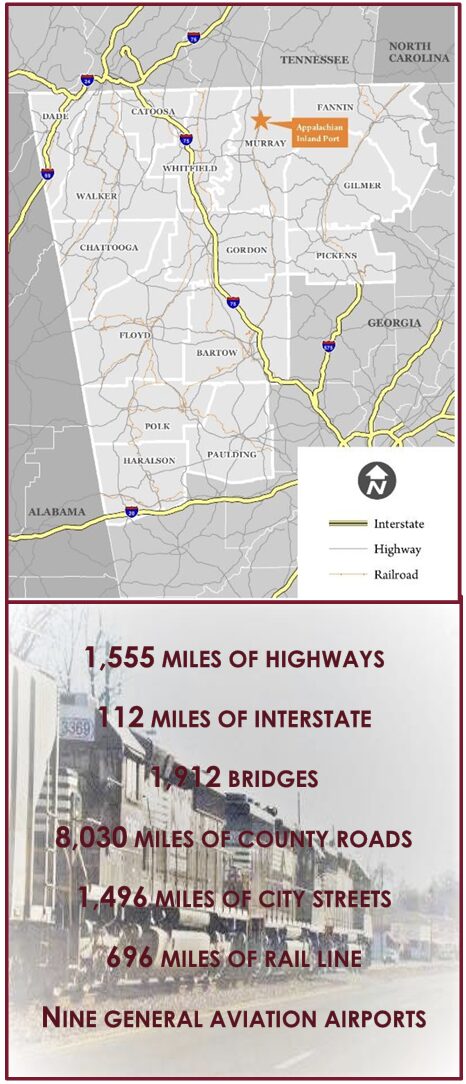
Northwest Georgia is served by an extensive roadway network (consisting of local roads, several state and federal highways, and three interstates) that traverses throughout the region. The primary transportation corridor in northwest Georgia is Interstate 75, which runs north-south through the eastern part of the Region connecting Atlanta and Chattanooga. Interstate 59 runs through Dade County in the extreme northwest corner of the region, and Interstate 20 runs through Haralson County in the extreme southwest. Additionally, Interstate 24 dips into northern Dade County for approximately four miles and Interstate 575 extends into Pickens County for less than one mile. Major US and state highways in the region primarily run northsouth parallel to I-75, making east-west transportation of goods somewhat problematic.
In Georgia, trucking is the dominant mode for carrying freight. Therefore, the performance of the highway network is critical for the transportation of freight into, out of, through, and within the northwest Georgia region. By 2040, the share of freight carried by trucking is projected to be 61.5% by weight and 62.4% by value. The interstate highways carry the highest volumes of freight at present and are expected to remain the principal facilities for transporting truck freight well into the future, with volumes projected to increase by as much as 177% by 2035. Some rural highways connecting urban areas to the interstates, such as US 411/SR 20 connecting Rome and Cartersville/I-75, are also expected to carry significant freight volumes in the future. Additionally, freight traffic on US 411 is projected to significantly increase as the Appalachian Inland Port in Murray County continues to expand.
Rail
Rail is an increasingly effective alternative for moving goods while relieving congestion and avoiding congested routes. Two major rail routes through northwest Georgia are rated for 50-74 tons and from 75-99 tons; there are smaller connector routes throughout the region as well. The construction of the Appalachian Inland Port has greatly enhanced northwest Georgia’s access to global markets. However, trucking will remain important to regional industries, as goods moving via other modes often use trucks for the first and last mile of the trip. Rail service is primarily provided by CSX and Norfolk Southern Railroads, although two short-line (Class III) railroads also operate in the region. Overall, existing rail service throughout the region is adequate with short-line operators moving into areas that might have otherwise been abandoned. While there is currently no high-speed commuter rail service in the region, state commuter rail studies are underway.
Transit
Mass transit services are provided in Rome, Georgia with fixed bus route services inside the city boundaries. The Region is also served by 10 Section 5311 Rural Public Transportation Programs, which provide a variety of services to each local community. Recent studies of transit systems in the region indicate a need for connectivity between counties, as well as increased access within county systems. While each county currently provides its own transit service, a coordinated approach to the delivery of these transportation services could be cost efficient and equally effective for all participants. Aviation No commercial service airports are located within the Northwest Georgia Region. However, three main Air Carrier Commuter Airports serve residents of the region; Hartsfield International Airport in Atlanta, Lovell Field Airport in Chattanooga, Tennessee and Birmingham Airport in Birmingham, Alabama. Additionally, nine general aviation airports are located within northwest Georgia. Several improvements to airports in the region have been identified in the Statewide Aviation Plan including increased runway length and other upgrades.
NWGRC Transportation Planning
The Northwest Georgia Regional Commission participates in planning activities with Georgia DOT District 6 in Cartersville, with the Chattanooga-Hamilton County Metropolitan Planning Organization, the Rome Metropolitan Planning Organization, the Dalton Metropolitan Planning Organization, the Cartersville-Bartow Metropolitan Planning Organization, the Metro Atlanta Metropolitan Planning Organization, Atlanta Regional Commission, Thrive Regional Partnership, and other agencies including those supporting the disabled, cyclists and pedestrians.
Contact NORTHWEST GEORGIA REGIONAL COMMISSION
Northwest Georgia Regional Commission
NWGRC Community & Economic Development
1 Jackson Hill - Rome, Georgia 30161
© 2026 Northwest Georgia Regional Commission Digital CEDS
Powered by StateBook