Summary Background
REGIONAL OVERVIEW
DEMOGRAPHICS
Population
The estimated population of Northwest Georgia was 927,899 in 2020. The Georgia’s Office of Planning and Budgeting expects the region’s population to increase at an annual rate of 0.78% over the next four years to reach a projected population in 2024 of 960,766. This growth rate, although lower than the historic rate for the region, is more than the anticipated growth rate of the United States according to the Census Bureau.
Northwest Georgia is a predominately rural region; however, the northern counties are part of the Chattanooga MSA and the southern

counties are within parts of the Atlanta metropolitan area. These counties, and those located along the I-75 corridor, continue to experience elevated population growth relative to other counties in the region. Paulding and Bartow counties continue to grow at a considerably higher rate than the rest of the region due to their location within commuting distance of the Metro Atlanta area. Likewise, Pickens and Gilmer counties are also experiencing elevated growth due to the construction of Highway 515, which connected these formerly rural counties to jobs in northern Atlanta.

Age
The median age in northwest Georgia is 39.4 years; a significant increase from the 2016 median age of 38.1 years. According to the Area Agency on Aging the aging population in the region has been growing significantly faster in recent years than the state average of 19.9%. The Governor’s office of Planning and budget has projected an increase in the senior population age 60+ of 58% by 2040. The 80-84 age group is expected to be the fastest growing population segment in northwest Georgia by percentage with a projected growth rate more than doubled by 2040. Murray and Paulding counties are expected to experience higher growth in the aging population at 85% and 213% respectively. The aging of the region’s population is especially concerning as much of the region is rural, limiting access to aging and long term-care services. The aging of northwest Georgia’s population also poses significant concerns for today’s workforce. As an elevated number of retirements are expected in the coming years, many employers are concerned about finding replacements with comparable skills, leadership ability, and management experience.
Race
According to U.S. Census Bureau, the white race represented 74.28% of the region’s population in 2020, a decline from 84.10% in 2010. The region’s 2020 white share was considerably higher than that for the state (50.06%) and nation (57.84%). The region’s black or African American share of total population increased from 7.94% in 2010 to 8.93% in 2020. The region’s 2020 black or African American share was considerably lower than that for the state (30.60%) and nation (12.05%). As compared to 2010, the percentage of the population that is Asian or of two or more races went up, while the percentage that is American Indian or Alaskan Native, Native Hawaiian/Other Pacific Islander, or some other race went down slightly.
The Census Bureau does not include Hispanic as a race. The census accounts for this population under ethnicity. Consequently, persons of Hispanic or Latino origin comprise portions of more than one racial group. The region’s Hispanic or Latino population accounted for 11.34% of the total in 2020, up from 9.54% in 2010. The 2020 share was higher than that of the state (10.49%) but lower than that of the nation (18.73%).

The retiring Baby Boomers created a significant management and experience gap, with Generation Xers, who make up a much smaller portion of the region’s population, not able to fill all vacated positions. Millennials are the largest living generation in the United States and have now fully entered the workforce with Generation Z beginning to graduate college and starting their first professional jobs. The influx of Millennials into the workforce created challenges with priorities and desires for employment that were at odds with the previous generations. Generation Z has brought new priorities to their professions and challenges of their own.
EDUCATION
A highly educated and skilled workforce is necessary to support economic competitiveness and resiliency. Education is vital when aligning worker skills with the needs of employers, which is critical to increasing productivity and growing the region’s economy. Improved high school graduation rates is an important first-step in ensuring the region has a skilled workforce, but it is also essential for the labor force to have an ample number of workers with advanced training, certifications, and degrees.
High School Graduation
According to the U.S. Census Bureau, approximately 83.1% of adult residents of northwest Georgia have attained a high school diploma or equivalent. The counties in the region with the highest percentage of high school graduates include Paulding (91%), Catoosa (89%), and Fannin (88%). The Counties with the lowest percentage of high school graduates include Whitfield (71%), Murray (72%), and Chattooga (72%). Each year, over ten thousand students graduate from the region’s public high schools. Northwest Georgia’s graduation rate was 91.0% in 2021. This is a significant increase over the 83.0% graduation rate in 2016. The public-school systems with the highest

graduation rates were Calhoun (100%), Chickamauga (100%) and Trion (98.7%) city schools and Murray (97.3%), Gordon (97.0%) and Haralson (96.6%) county schools. These graduating seniors represent the future workforce of northwest Georgia and should be encouraged to participate in apprenticeships, internships, and on-the-job training programs; attend technical college; or enroll in traditional colleges and universities in order to achieve their career goals. (2021 Four-Year Graduation Rates by county are listed in the appendix.)

College and Career Academies
In northwest Georgia, high schools and their post-secondary partners are joining together to create local college and career academies to prepare high school students to meet the needs of employers in advanced manufacturing and other highskilled professions. College and Career Academies are unique learning environments that provide the best opportunities for school systems to focus educational resources on the needs of their community, local businesses, and area industries. Working closely with local employers, eleven communities in northwest Georgia have established college and career academies; these include Floyd County College and Career Academy (in Rome), City of Rome College and Career Academy, Catoosa County College and Career Academy (in Ringgold), Fannin County College and Career Academy (in Blue Ridge), Gordon County College and Career Academy (in Calhoun), Haralson County College and Career Academy, Northwest Georgia College and Career Academy (in Dalton), Bartow County College and Career Academy (in Cartersville), Paulding County College & Career Academy (in Dallas), Polk County College and Career Academy (in Rockmart), and Calhoun City College and Career Academy (in Calhoun).
Educational Attainment
More than 80% of the region’s population over 25 years old are high school graduates or higher. Approximately 25% have a college degree, including 7.8% with an associate’s degree, 12.0% with a bachelor’s degree, and 7.0% with a graduate or professional degree. Unfortunately, this leaves approximately 15% of the adult population with less than a high school degree, and 6.3% of the adult population has less than a 9th grade education. For the region to attract and retain professional, technology, or advanced manufacturingoriented employers, the workforce needs additional skilled workers with technical training, certifications, and degrees, as well as a college educated and professional workforce component.
Institutions of Higher Education
Post-secondary education in northwest Georgia is provided by the Technical College System of Georgia, the University System of Georgia, and private colleges. Three technical colleges serve the region; including Georgia Northwestern Technical College with campuses in Floyd, Walker, Catoosa, Gordon, Polk, and Whitfield counties; Chattahoochee Technical College with campuses in Pickens, Bartow, and Paulding counties; and West Georgia Technical College with a campus in Haralson County. The technical college system provides a broad range of career opportunities through a variety of certificate, diploma, and associate degree programs; continuing education programs; and economic development programs. Two University System of Georgia colleges also serve northwest Georgia; Georgia Highlands College in Floyd County and Dalton State College in Whitfield County. Additionally, University of North Georgia, Kennesaw State University, and University of West Georgia have satellite campuses in the region. Berry College, Shorter University, and Covenant College are also located in the area.
WORKFORCE
According to the American Community Survey, there were approximately 345,000 workers residing in northwest Georgia in 2020. Of these, approximately 53.6% worked in their county of residence, 36.1% worked in Georgia but outside their county of residence, and 10.3% worked outside the state of Georgia.
Employment by Industry
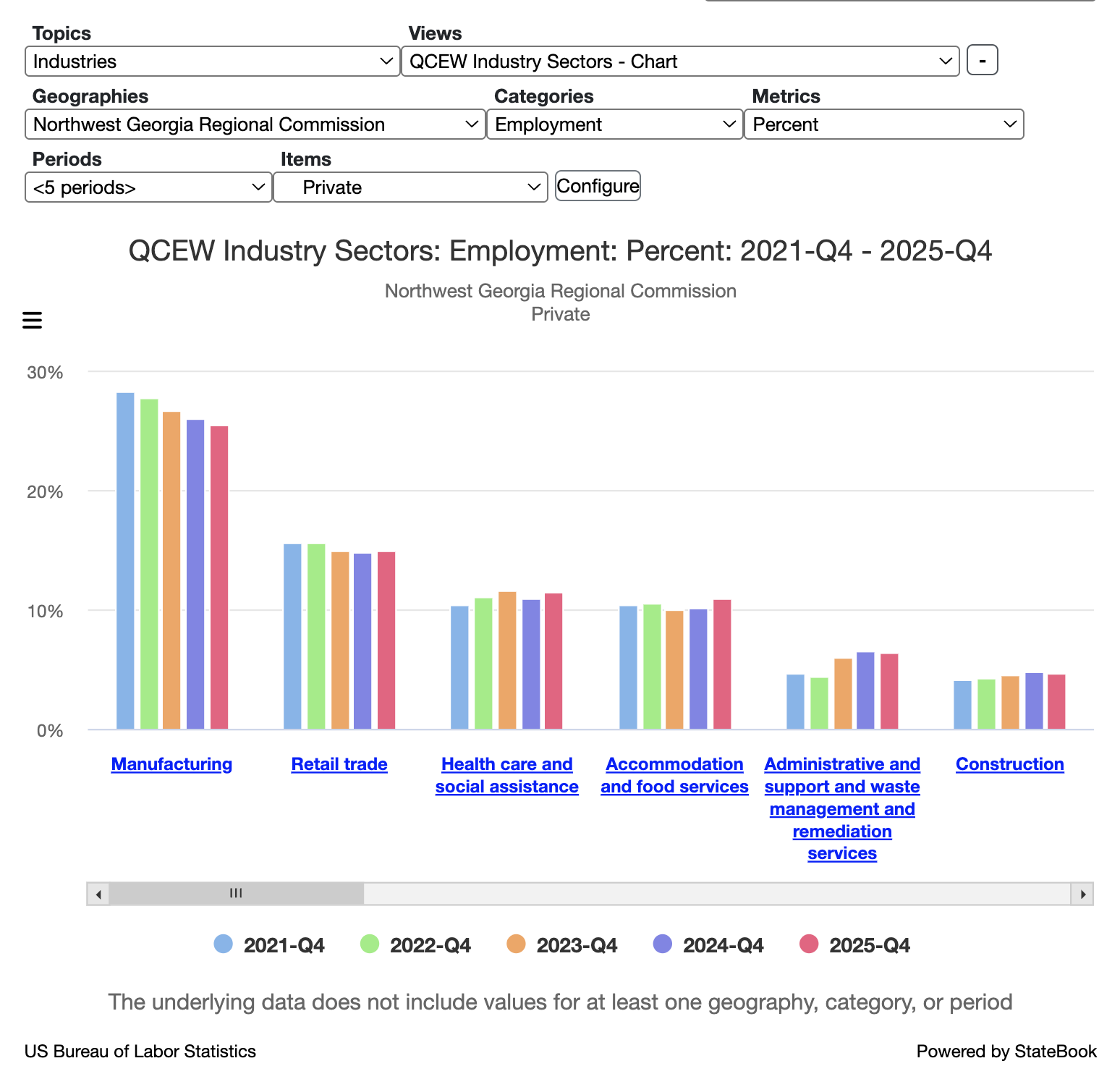
The largest number of workers in the region are employed in the manufacturing industry which retains 22.52% of the labor force. While the Educational services, and health care and social assistance industry employs 19.32% of the labor force and the retail trade industry employs 10.92% of the labor force. Each of the other industry sectors employs less than 10% of northwest Georgia’s laborers.
Employment by Occupation
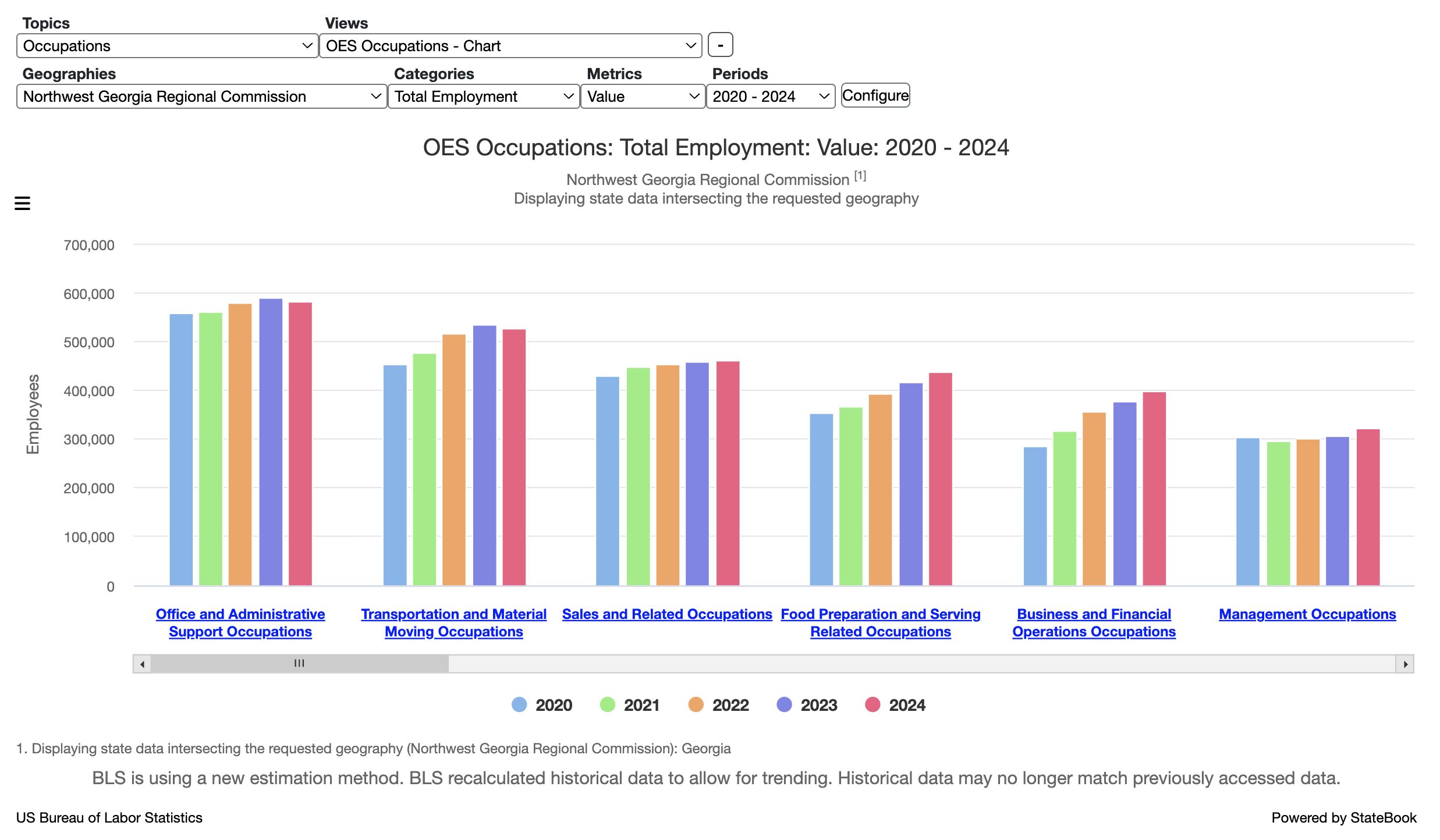
The largest percent of northwest Georgia’s workers are employed in management, business, science, and arts occupations jobs at 27.75% of the workforce. Production, transportation, and material moving occupations employ the next largest percent at 22.59%; while sales and office occupations employ close to the same number of workers at 21.92%. Service occupations employ 15.88%. Natural resources, construction, and maintenance occupations employ 11.87% of the region’s workforce.

Unemployment
As previously discussed, unemployment in the region has largely recovered from the COVID-19 pandemic, with the 24-Month Unemployment Rate for northwest Georgia at 5.56%, which is only 0.6% higher than the national rate.
Long-term Industry Projections
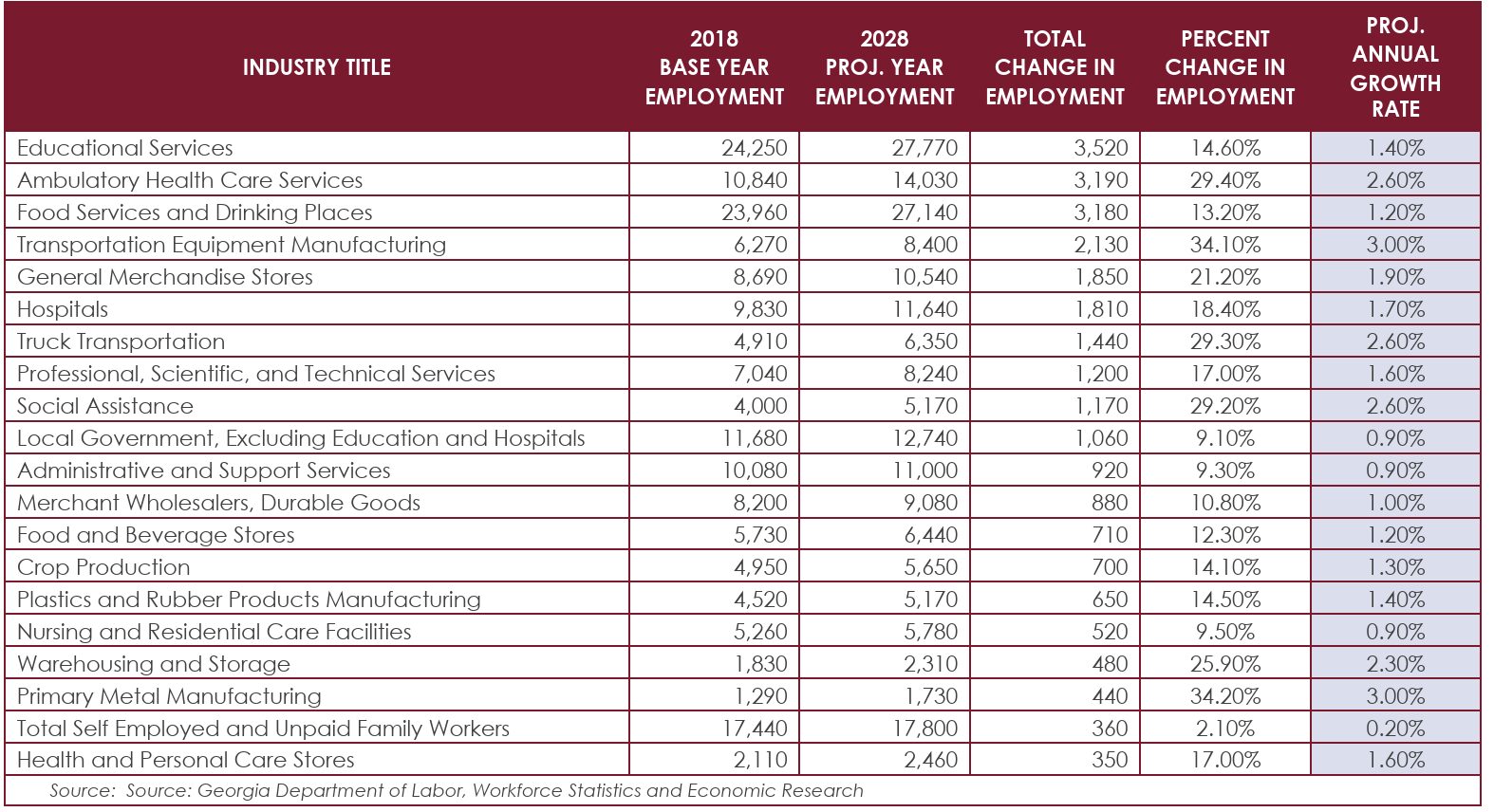
The Georgia Department of Labor published long-term employment projections for the Northwest Georgia Region in which they predict 2028 employment in select industries. According to this study, educational services (although at a slower rate than the previous 5 years) will continue to see the highest number of jobs added with 3,520 by 2028 with an annual growth rate of 1.40%. The industry sector with the highest project annual growth rate, however, is Transportation Equipment Manufacturing, which is projected to see an annual growth rate of 3.00% for a total of 2,130 new jobs in 2028.
TRANSPORTATION
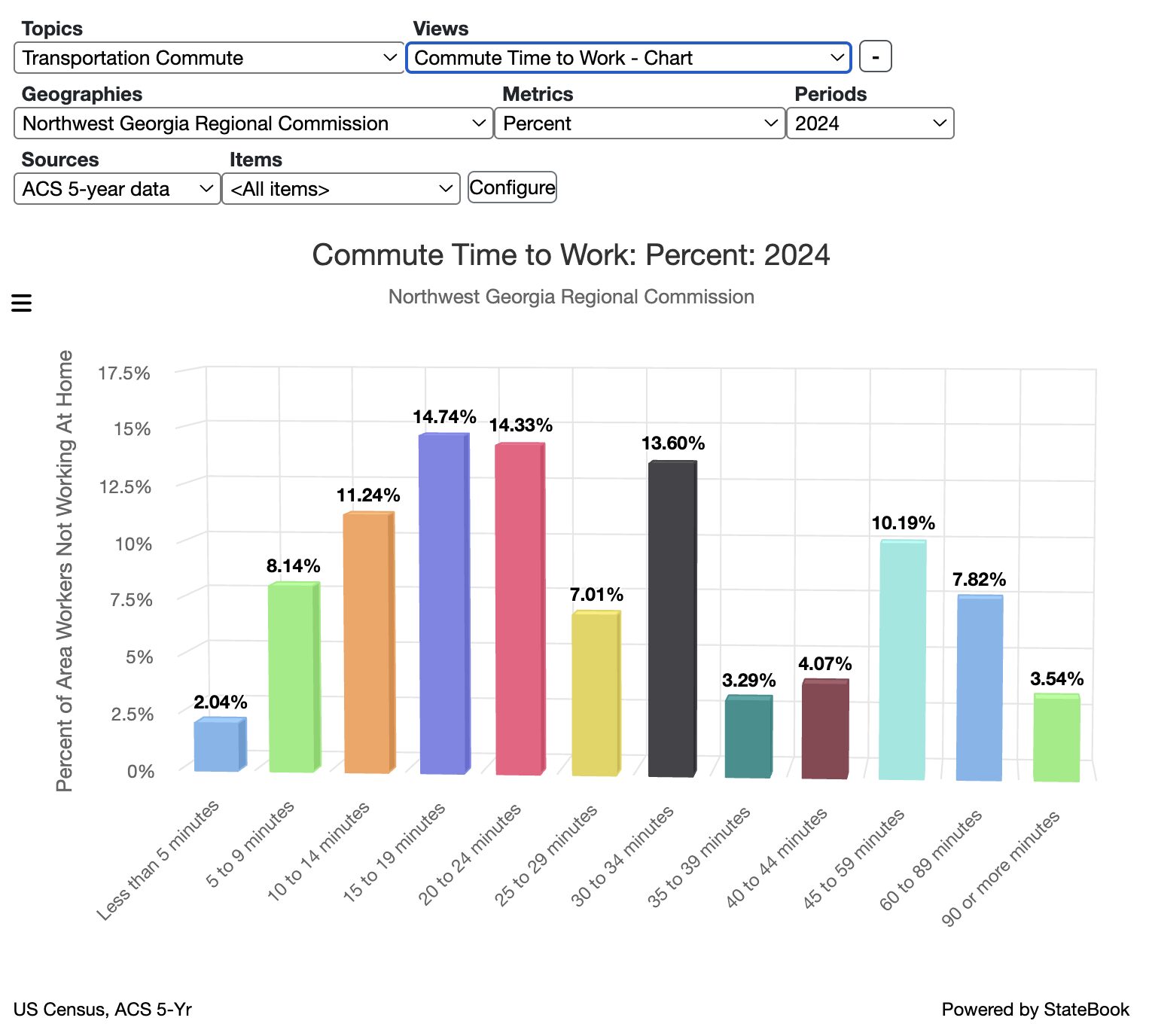
An adequate, safe, and reliable transportation network, with access to both urban and rural areas, is vital to the economic growth and economic prosperity of the Northwest Georgia Region. Without access to a well-maintained, multi-modal transportation network, goods and raw materials could not efficiently move into or out of the region – resulting in low economic productivity. Reliable transportation, including transit and bike/pedestrian facilities, is also necessary to ensure employees can arrive at work safely and on time. The Region’s transportation network includes interstates I-75, I-20, and I-59 as well as several US and state highways, railways, airports and public transit.
Roadway
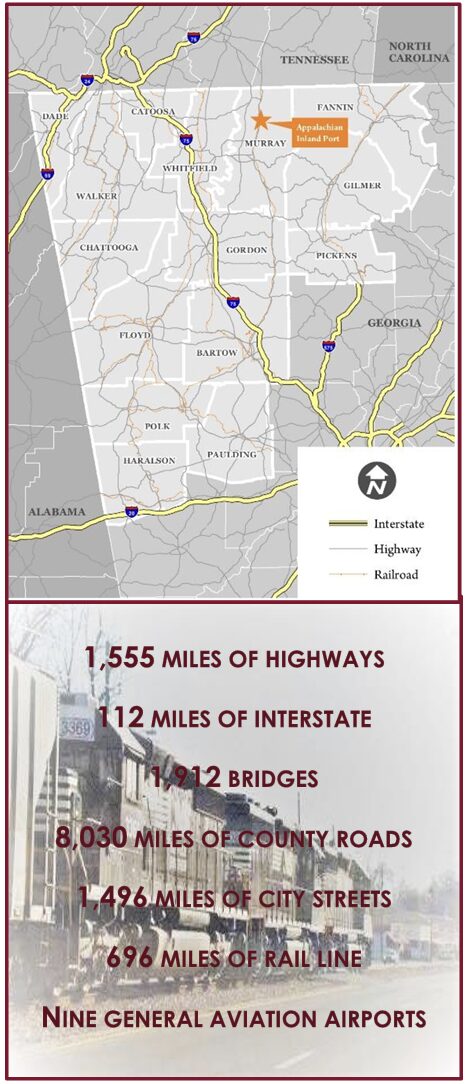
Northwest Georgia is served by an extensive roadway network (consisting of local roads, several state and federal highways, and three interstates) that traverses throughout the region. The primary transportation corridor in northwest Georgia is Interstate 75, which runs north-south through the eastern part of the Region connecting Atlanta and Chattanooga. Interstate 59 runs through Dade County in the extreme northwest corner of the region, and Interstate 20 runs through Haralson County in the extreme southwest. Additionally, Interstate 24 dips into northern Dade County for approximately four miles and Interstate 575 extends into Pickens County for less than one mile. Major US and state highways in the region primarily run northsouth parallel to I-75, making east-west transportation of goods somewhat problematic.
In Georgia, trucking is the dominant mode for carrying freight. Therefore, the performance of the highway network is critical for the transportation of freight into, out of, through, and within the northwest Georgia region. By 2040, the share of freight carried by trucking is projected to be 61.5% by weight and 62.4% by value. The interstate highways carry the highest volumes of freight at present and are expected to remain the principal facilities for transporting truck freight well into the future, with volumes projected to increase by as much as 177% by 2035. Some rural highways connecting urban areas to the interstates, such as US 411/SR 20 connecting Rome and Cartersville/I-75, are also expected to carry significant freight volumes in the future. Additionally, freight traffic on US 411 is projected to significantly increase as the Appalachian Inland Port in Murray County continues to expand.
Rail
Rail is an increasingly effective alternative for moving goods while relieving congestion and avoiding congested routes. Two major rail routes through northwest Georgia are rated for 50-74 tons and from 75-99 tons; there are smaller connector routes throughout the region as well. The construction of the Appalachian Inland Port has greatly enhanced northwest Georgia’s access to global markets. However, trucking will remain important to regional industries, as goods moving via other modes often use trucks for the first and last mile of the trip. Rail service is primarily provided by CSX and Norfolk Southern Railroads, although two short-line (Class III) railroads also operate in the region. Overall, existing rail service throughout the region is adequate with short-line operators moving into areas that might have otherwise been abandoned. While there is currently no high-speed commuter rail service in the region, state commuter rail studies are underway.
Transit
Mass transit services are provided in Rome, Georgia with fixed bus route services inside the city boundaries. The Region is also served by 10 Section 5311 Rural Public Transportation Programs, which provide a variety of services to each local community. Recent studies of transit systems in the region indicate a need for connectivity between counties, as well as increased access within county systems. While each county currently provides its own transit service, a coordinated approach to the delivery of these transportation services could be cost efficient and equally effective for all participants. Aviation No commercial service airports are located within the Northwest Georgia Region. However, three main Air Carrier Commuter Airports serve residents of the region; Hartsfield International Airport in Atlanta, Lovell Field Airport in Chattanooga, Tennessee and Birmingham Airport in Birmingham, Alabama. Additionally, nine general aviation airports are located within northwest Georgia. Several improvements to airports in the region have been identified in the Statewide Aviation Plan including increased runway length and other upgrades.
NWGRC Transportation Planning
The Northwest Georgia Regional Commission participates in planning activities with Georgia DOT District 6 in Cartersville, with the Chattanooga-Hamilton County Metropolitan Planning Organization, the Rome Metropolitan Planning Organization, the Dalton Metropolitan Planning Organization, the Cartersville-Bartow Metropolitan Planning Organization, the Metro Atlanta Metropolitan Planning Organization, Atlanta Regional Commission, Thrive Regional Partnership, and other agencies including those supporting the disabled, cyclists and pedestrians.
COVID-19 IMPACT ON THE ECONOMY
The negative economic impacts of the COVID-19 pandemic in Northwest Georgia were significant; however, the region began to recover in the second half of 2020. The area’s economy continued its recovery during 2021 and 2022, with only minor disruptions as new Covid-19 cases spiked during early Summer 2021. Data suggests that a similar disruption in the region’s economic recovery was not experienced during the surge in new cases caused by the Delta or Omicron variants.
Key takeaways from the NWGRC Economic Impact Analysis; Impact of COVID-19 on Northwest Georgia include:
- The Manufacturing Sector, which is the largest sector of the region’s economy according to the Georgia Department of Labor Area Labor Profile for Northwest Georgia Regional Commission, was hit hard by COVID-19.
- According to the Demographic Atlas of the United States, all five of the counties with the highest weekly unemployment claims during the March 7 – June 13 period when the pandemic hit hardest have Manufacturing as their largest sector.
- Manufacturing had significantly more weekly unemployment claims than any other sector.
- The 2-digit NAICS Code industry sector that lost the most jobs in 9 of the 15 counties was Manufacturing.

- The Food Services industry subsector of the economy was also hit hard.
- 12 of the region’s 15 counties had Accommodations and Food Services as the largest or second-largest 2-digit NAICS Code industry sector in terms of weekly job claims.
- Food Services & Drinking Places was the 3-digit NAICS Code subsector that lost the most jobs between March 7 & June 13 for 10 of the region’s 15 counties.
- Community leaders listed Food Services as the industry hit the hardest more commonly than any other industry in the Georgia Tech EDA University Center survey.
- The unemployment rate peaked in April and has since gone down to a level slightly above what it was pre-pandemic.
- Low-income workers were hit less hard by the pandemic in the region than in many other parts of the country.
- According to a model used by the University of Georgia, had the jobs lost in the first few months of the pandemic remained lost for a year, this would have resulted in the loss of most of the region’s employee compensation and gross regional product (the value of the goods and services produced by the region).
- Most of the region collected more sales tax revenue in 2020 than in 2019 despite the pandemic. The combination of an increase in revenue from general merchandise and a decrease in revenue from wholesale indicates that retail moved online.
- A survey conducted by Georgia Tech’s EDA University Center found that businesses experienced significant revenue loss problems but that most unemployment due to the pandemic has already occurred. Community leaders and companies expressed that more assistance with finding ways to make revenue, more employee development, and more leadership development were needed for businesses. Community leaders indicated that business location, expansion, and relocation projects were either not affected or have resumed work.
NWGRC’s COVID – 19 Response
In early March, Georgia Governor Brian Kemp issued a stay-at-home order for all Georgians in response to the onset of the COVID-19 Pandemic. To ensure continued, consistent, and efficient communication with the region’s 15 counties and 49 cities the Community and Economic Development team made the decision to use the NWGRC Community and Economic Development Newsletter as a platform to guide that communication. The Community and Economic Development team significantly increased communication with northwest Georgia local governments to disseminate information regarding the impact of COVID-19, any assistance to be available, and provide NWGRC’s state and federal partners the platform to share valuable information with the region.
Newsletters consisted of informative articles which detailed various topics such as the American Recovery Plan Act, the region’s economic impact assessment and recovery plan, and upcoming webinars and grant opportunities. Additionally, in 2021 and 2022, NWGRC hosted several webinars and workshops on a number of topics including Appalachian Regional Commission, downtown development, and financing water and sewer infrastructure projects. Participating partners included Appalachian Regional Commission (ARC), Georgia Department of Community Affairs (DCA), Georgia Environmental Finance Authority (GEFA), United States Department of Agriculture-Rural Development (USDA-RD), United States Economic Development Administration (EDA), and the Georgia Municipal Association. Participation in these events ranged from 30 to 35 attendees.
The results of the increased newsletters and webinars included the local governments contacting the Community and Economic Development Team to request grant assistance and project development with economic recovery from the COVID-19 Pandemic. Likewise, local governments have had the opportunity to learn more about northwest Georgia’s state and federal partnerships.

Contact NORTHWEST GEORGIA REGIONAL COMMISSION
Northwest Georgia Regional Commission
NWGRC Community & Economic Development
1 Jackson Hill - Rome, Georgia 30161
© 2026 Northwest Georgia Regional Commission Digital CEDS
Powered by StateBook